Table of Contents
For global certification programs payment friction is a silent obstacle that costs real revenue. Nearly 40% of learners drop off at checkout simply because they can’t pay the way they prefer.
As your program expands into high-growth markets, across Asia and other emerging regions, this challenge becomes impossible to ignore. In many of these markets, credit cards aren’t the norm, and the payment experience can make or break a learner’s journey.
This article explores how to localize your payment strategy for global success. You’ll uncover the hidden costs of a poor checkout experience, understand the impact of local payment preferences, and learn how addressing payment friction can become a powerful competitive advantage.
Why local payments are transforming global education
For any assessment platform owner looking to grow, understanding the payment landscape in emerging markets is non-negotiable. In markets where traditional banking infrastructure is limited or where trust in international credit cards is low, alternative payment methods have emerged not just as an option, but as the default preference for millions.
What are alternative payment methods (APMs)?
They refer to any form of digital or electronic payment that does not rely on traditional credit or debit card infrastructure. These methods, which include digital wallets, mobile money, and local bank transfers, are tailored to the financial ecosystems of fast-growing economies.
Their core appeal lies in their flexibility, speed, and ability to facilitate transactions for high-stakes assessments without the friction of legacy systems. What truly sets APMs apart is their adaptability. In regions where consumers are more familiar with mobile phones than bank branches, APMs provide a streamlined, user-friendly way for a candidate to pay.
Common types of local payments driving access for your test-takers include:
- Digital wallets: Apps that store funds electronically for instant online payments.
- Mobile money: Telecom-based services that allow users to send and receive money using basic mobile phones.
- Bank transfers: Direct, local bank-to-bank transfers, often supported by real-time payment (RTP) systems for instant confirmation.
- QR code payments: Cashless solutions where users scan a QR code to complete payment directly from their mobile wallet or banking app.
The rapid adoption of alternative payment methods is a direct response to local challenges. A significant portion of the population in these markets is either unbanked or underbanked. Limited access to physical banks, low trust in financial institutions, or insufficient income make traditional banking impractical. Conversely, mobile phones and internet access are widespread, creating the perfect environment for these mobile-first, low-barrier solutions to thrive.
To grow your certification program, you need to offer local payment options. They help remove barriers at checkout, making it easier for learners to complete their enrollment. In short, alternative payment methods are the key to reducing friction and reaching more candidates.
Breaking into new markets: The 4 key challenges for certification platforms
Expanding into emerging markets offers great growth potential, but it also brings new challenges. Each region has different rules and ways people prefer to pay. Without local payment options, your certification program may face lower enrollment rates, more manual work, and higher customer support demands.
Here are the key challenges that credentialing organizations must address to succeed:
1. Varied local payment preferences
This is the single biggest driver of checkout abandonment. Unlike in developed markets where card payments are standard, consumers in emerging economies rely on a diverse range of local payments. If your digital assessment checkout only accepts international credit cards, you are excluding a vast number of potential candidates. You are forcing them to find a payment method they don’t have, don’t trust, or can’t access. That friction is why they drop off.

2. Regulatory and compliance challenges
Each region has unique financial regulations, local tax requirements, and data protection rules. For a global certification provider, managing this complexity creates a high operational burden. Your team must constantly track and adhere to diverse local requirements, taking focus away from your core mission of providing tests.
3. Security concerns
Higher fraud rates and cyber threats in some emerging regions reinforce the need for robust security. For high-stakes credentialing assessments, integrity is everything. Companies need advanced, AI-powered fraud prevention mechanisms to minimize losses and, just as importantly, maintain the trust of exam-takers.
4. Currency volatility and settlement issues
Handling multiple currencies and facilitating fast, cost-effective settlements is a major hurdle. Many assessment program owners struggle with high foreign exchange fees, delayed cross-border settlements, and unpredictable exchange rate fluctuations. This not only strains your finance department but also damages learner trust when they are hit with hidden costs from currency conversions.
How payment gateway technology supports global expansion
To unlock the full potential of emerging markets, credentialing organizations need more than just ambition—they need infrastructure that adapts to regional realities. A modern, flexible technology payment gateway acts as the critical enabler, making it possible to localize payment experiences and ensure instant exam confirmation.
Here’s how the right payment gateway empowers your global testing program to succeed and solves the challenges of expansion.
- Seamless integration with local payments: A robust payment gateway connects your certification platform to hundreds of local payment methods through a single integration. This eliminates the need for your team to negotiate multiple contracts or build dozens of separate integrations. You can instantly enable the trusted payment options in each market, directly solving the conversion problem and allowing exams to be booked faster.
- Multi-currency processing: Supporting local currencies is no longer optional, it’s expected. Candidates are far more likely to enroll when they can pay in their own currency without facing hidden fees. A capable gateway provides real-time currency conversion at checkout to build transparency.
- Advanced security and fraud prevention: A modern gateway must be equipped with AI-powered fraud detection, data tokenization, and real-time monitoring to mitigate threats. These tools are designed to protect revenue from fraud and strengthen exam-taker confidence, both of which are critical for high-stakes programs.
- Scalability for global growth: As your test center network expands, your payment systems must scale with you. A flexible gateway provides access to a global network of local acquirers, making it easy to enter new regions without rebuilding your infrastructure or compromising the speed required for computer-based testing.
- Driving financial inclusion: By supporting mobile money and digital wallets, your certification program actively participates in closing the financial inclusion gap. You are enabling unbanked and underbanked learners to access your global training and assessments using the digital-first tools they already have.
From payment challenge to “Quadruple win”
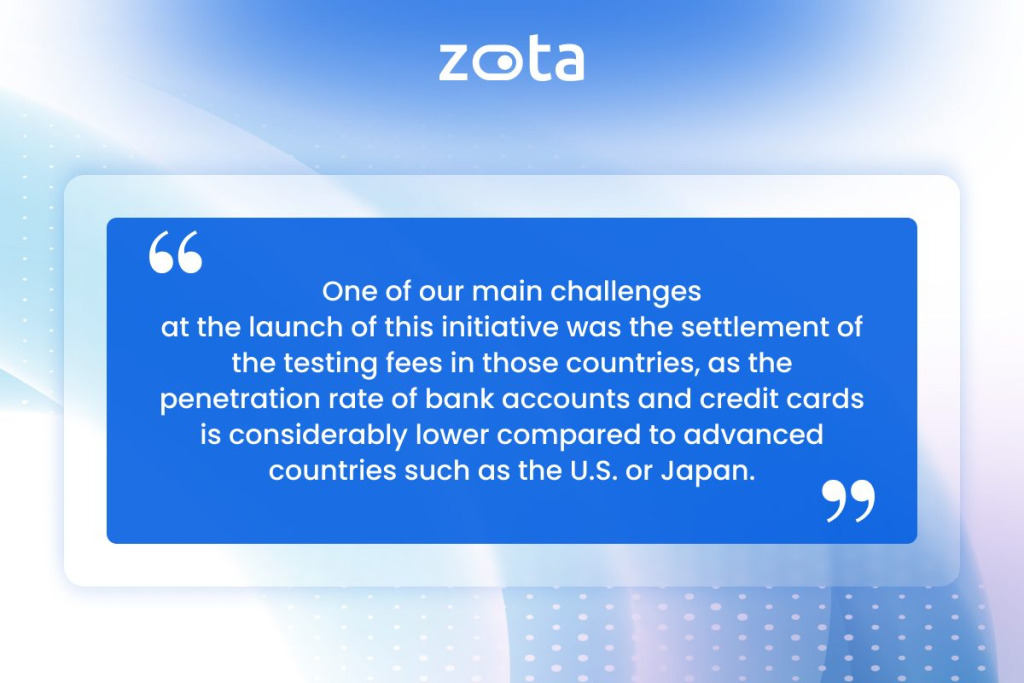
The impact of a localized payment strategy is not theoretical. For one leading global certification and testing organization, expanding its mission in APAC was critical. The goal was to certify young, ambitious people in countries like the Philippines and Indonesia to invite them as skilled workers to Japan. But they hit a wall.
As their Vice President and CFO for Japan explained,
The solution was to partner with a payment provider who understood the local landscape.

Conclusion
Alternative payment methods aren’t just a convenience, they are your gateway to certification program growth. Navigating the complexities of Asia and other emerging markets requires a smart, localized payment solution.
The payment friction that causes candidates to drop off is solvable. The key is to remove the barrier, stop forcing candidates to use international cards, and instead offer the seamless, secure, and familiar checkout experience they expect.
Zota’s payment gateway technology is purpose-built for the realities of these fast-growing regions, supporting a wide range of alternative payment methods like eWallets, QR codes, and instant wire transfers, all in local currencies. We help certification organizations eliminate the checkout barrier, enhance candidate trust with transparent pricing, and deliver secure transactions tailored to local expectations.
Let Zota be your trusted partner in unlocking the full conversion potential of your exam delivery in emerging markets. Contact us today.